Making Charges Explained (2026 Guide): How Jewellers Calculate Final Gold Jewellery Price in India
gold jewellery pricing in 2026. Learn how making charges (per gram vs %), wastage, 9K gold (375) hallmarking, and GST breakup affect your final bill.ion.
1/16/20264 min read
Making Charges Explained (2026 Guide): How Jewellers Calculate Final Gold Jewellery Price in India (With Real Bill Examples)
Most Indians know today’s gold price.
But almost nobody knows the real gold jewellery price formula.
That’s why two people can buy the “same looking chain” and still pay ₹5,000–₹25,000 difference.
In 2026, smart buyers don’t lose money on gold rate — they lose money on:
making charges
wastage/VA
stones weight confusion
unclear GST breakup
This guide will make you unbeatable in any jewellery shop.
⚡ Quick 2026 Shop Checklist (Do This Before You Pay)
Before you swipe your card, take 30 seconds:
✅ Step 1: Open BIS CARE App
✅ Step 2: Verify HUID (6-digit alphanumeric)
✅ Step 3: Match Purity Stamp on jewellery:
916 = 22K
750 = 18K
375 = 9K (2026 budget trend)
✅ Step 4: Ask for Bill Breakup
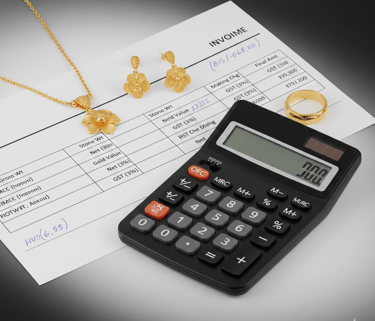
Your invoice must show these separately:
Gold value
Making charges
GST
If they give a “single total” without breakup — that’s a red flag.
1) The Real 2026 Gold Jewellery Price Formula
Forget “gold rate × weight”.
Jewellery pricing follows this structure:
✅ Final Price =
Gold Value + Making Charges + Wastage/VA (if separate) + Hallmark/HUID charges (if shown) + GST
That’s it.
If you understand this formula, nobody can confuse you in the shop.
2) What Are Making Charges? (Real Meaning)
Making charges are the cost of:
craftsmanship (handwork)
machinery cutting
polish & finishing
design and labour
Jewellery is not just gold. It’s gold + work.
✅ Making charges are normal.
❌ Making charges being unclear is the problem.
3) The Two Methods: Per Gram vs Percentage (MOST IMPORTANT)
Jewellers use 2 methods.
✅ Method A: Per Gram Making Charges (Best & Transparent)
This is the cleanest system.
Example:
₹600 per gram × 10g = ₹6,000 making
✅ Stable (gold rate change doesn’t change labour)
✅ Easy to compare between shops
✅ Buyer-friendly
⚠️ Method B: Percentage Making Charges (The Expensive Trap)
Example:
12% of gold value
If your gold value is ₹70,000:
Making = 12% = ₹8,400
🚨 Trap: if gold rate increases, making increases automatically.
Even though labour cost is the same.
4) Ultra Clear Table: Per Gram vs Percentage (Real Cost Difference)
Assume:
Net gold weight = 10g
Gold rate = ₹7,000/g
Gold value = ₹70,000
Making Charge TypeCalculationMaking ChargePer gram10 × ₹600₹6,000Percentage 12%12% of ₹70,000₹8,400
✅ Difference = ₹2,400 extra (same jewellery, same labour)
Now imagine bangles (30g–50g). Difference becomes huge.
5) The “Wastage / VA” Game (Where Bills Become Dangerous)
Wastage (VA = Value Addition) means gold lost during:
melting
shaping
polishing
In 2026, wastage is shown in 2 ways:
✅ included inside making
OR
⚠️ added separately as VA%
Example:
VA 10% means extra cost is added.
✅ Always ask:
“Wastage included? Or separate VA?”
6) GST & Bill Breakup: Why It Matters in 2026
GST confusion happens because buyers don’t demand clear breakup.
✅ Your invoice must show:
gold value line
making charges line
GST line
⚠️ If shop prints bill like:
“TOTAL ₹1,25,000 incl. GST”
…and doesn’t show breakup properly → buyer loses clarity.
✅ Smart buyer line:
“Gold value and making charge separate mention maadi.”
Note: GST billing classification may vary. For high value purchases, confirm with invoice / CA.
7) The 9K Gold Trend (375): 2026 Budget Option
2026 = high gold price era.
So budget jewellery is booming.
✅ 9K gold purity stamp:
375 = 9K gold
✅ Great for: daily wear chains, small rings, office wear
⚠️ Not ideal if you want “traditional heavy gold investment”
BIG TIP:
9K jewellery is often machine-made.
So making charges should be:
✅ 30–40% lower than handmade 22K jewellery.
If they charge heavy wedding jewellery making for 9K → overcharging.
8) Stones & Diamonds: The Net Weight Rule (Non-Negotiable)
If jewellery has stones:
Ruby, emerald, beads, diamonds, AD stones etc.
Invoice must show:
✅ Gross Weight (total)
✅ Stone Weight
✅ Net Gold Weight
🚨 Rule:
Never pay gold rate on stone weight.
That’s one of the most common silent losses.
9) 3 Real-Life Price Examples (2026)
Example 1: 22K Chain (10g)
Gold rate: ₹7,000/g
Net gold: 10g
Gold value = ₹70,000
Per gram making: 10 × ₹600 = ₹6,000
Final (before GST) = ₹76,000
If percentage making 12%:
12% of 70,000 = ₹8,400
Final (before GST) = ₹78,400
✅ Difference = ₹2,400
Example 2: 22K Bangles (40g)
Gold value = 40 × 7,000 = ₹2,80,000
Per gram making ₹800/g → 40×800 = ₹32,000
Percentage 12% → 33,600
Difference looks small?
But some showrooms charge 18%–25% on premium designs.
Then you’ll lose ₹20,000+ easily.
Example 3: 9K Ring (375) for daily wear (6g gross)
Net gold: 5g
Gold rate: ₹3,200/g
Gold value = ₹16,000
Machine jewellery making should be modest (ex: ₹300/g)
Making = 5×300 = ₹1,500
Subtotal = ₹17,500 (+GST)
If shop charges ₹5,000 making for same ring = overcharging.
10) Red Flags (If You See This → Leave the Shop)
These 7 signals expose overpricing:
🚩 “Bill breakup not available”
🚩 “Net weight not mentioned”
🚩 “Stone weight not mentioned”
🚩 “Making charges not explained (only total)”
🚩 “HUID verification not allowed”
🚩 “Hallmark fee too high without reason”
🚩 “Only verbal promises, no written invoice clarity”
11) 7 Questions to Ask Before Paying (Copy & Use)
Is this BIS hallmarked with HUID?
Can I verify HUID in BIS Care app now?
What is net gold weight (excluding stones)?
Making charges per gram or %?
Is wastage included in making?
Is GST shown clearly with breakup?
What is buyback/exchange policy in writing?
Conclusion: Proof Beats Trust in 2026
Gold jewellery is emotional, but billing must be logical.
In 2026:
✅ Trust is good
✅ But proof is better
So follow this rule:
Buy jewellery with love — pay only after clarity.
Quick Summary (for fast readers)
✅ Compare making charges per gram vs %
✅ Always check net gold weight
✅ BIS Care app verification is non-negotiable
✅ 9K (375) can be smart for budget daily wear
✅ Bill breakup protects you legally and financially
FAQ
Q1: Are making charges negotiable?
Yes, in many shops. Usually more negotiable on plain jewellery than heavy designer work.
Q2: Which is better: per gram or percentage making?
Per gram is more transparent and buyer-friendly.
Q3: Can I buy gold without a bill to save GST?
Not recommended. Without invoice, you lose:
purity proof
HUID verification evidence
exchange/resale strength later
Q4: Is 9K gold hallmarked in India?
Yes, 9K jewellery has purity stamp 375 and can be verified through BIS process.
Disclaimer
This guide is for educational purposes only. Jewellery pricing and billing formats may vary by jeweller. Always verify HUID via BIS Care app and confirm invoice breakup for final purchase decisions.